Google Developers Blog
20 stories

Google Developers BlogLabsUnifying Edge AI: How Coral NPU’s open standard brings portable, energy-viable intelligence from model to silicon Google Research has completed the 32-bit open-source Coral NPU RISC-V architecture with the introduction of its Matrix Execution Unit, which delivers up to 1 TOPS while targeting 10 mW average power…

Google Developers BlogLabsBringing Visual Graph Debugging to Custom Edge Compilers with Model Explorer Google AI Edge Model Explorer now supports custom compiler intermediate representations and open-source adapters like TOSA, VGF, and PTE for on-device machine learning.

Google Developers BlogLabsIntegrating TorchTPU into TorchTitan and Optimizing Models for TPU TorchTPU integrates a native torch.device("tpu") backend directly into PyTorch, allowing developers to train large-scale models on Google Cloud TPUs without rewriting code in JAX.

Google Developers BlogLabsAnnouncing New vLLM and SGLang Inference Engines on TPU This post announces native PyTorch backends for vLLM and SGLang powered by TorchTPU, enabling developers to run and optimize serving workloads using familiar PyTorch tools.

Google Developers BlogLabsNative Model Authoring for Edge with LiteRT Tensor API Meet the LiteRT Tensor API: giving developers native C++ control over the model graph to unify end-to-end ML computations on heterogeneous edge hardware.

Google Developers BlogLabsStep by Step guide: Build a Voice Agent That Never Goes Silent using ADK The open-source Agent Development Kit (ADK) and gemini-3.8-live enable developers to build responsive voice agents by implementing non-blocking tools in Python.

Google Developers BlogLabsAnnouncing DPoP Support for Google OAuth: Securing Refresh Tokens Google OAuth Platform now supports DPoP (Demonstrating Proof-of-Possession) to sender-constrain refresh tokens, neutralizing Infostealer malware and adversary-in-the-middle attacks.
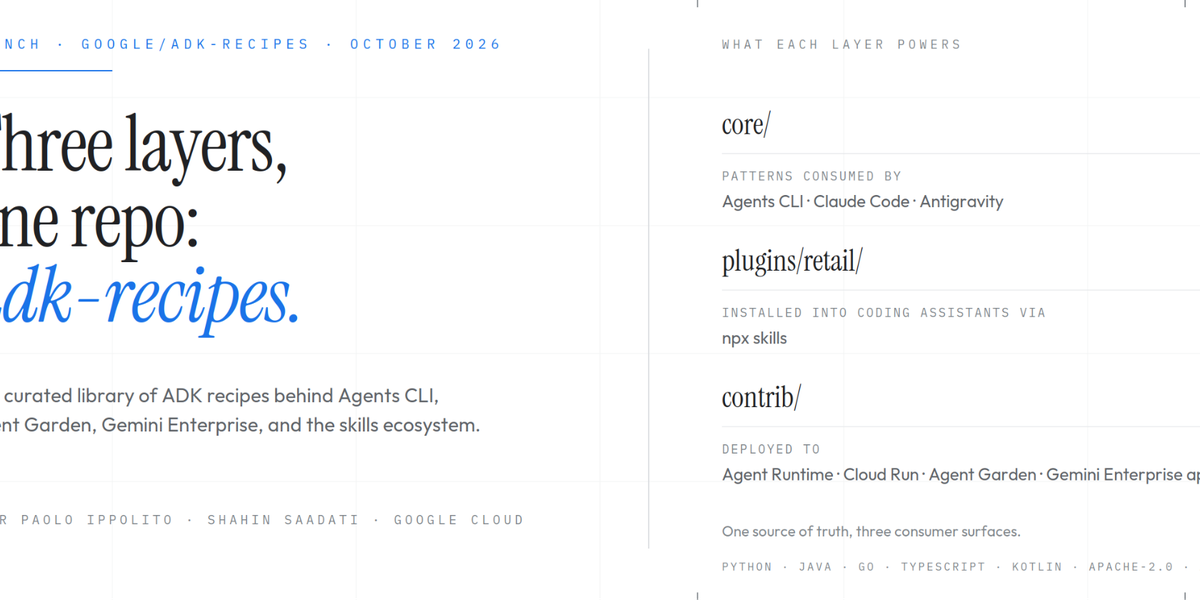
Google Developers BlogLabsThree layers, one repo: a tour of google/adk-recipes The google/adk-recipes repository unifies Agent Development Kit (ADK) resources into three structured layers—core/, plugins/, and contrib/—serving as a single source of truth for building AI agents.

Google Developers BlogLabsEvaluating AI agents: moving past the vibe check A practical engineering guide and reference architecture for establishing continuous evaluation pipelines for multi-turn AI agents using Gemini Enterprise Agent Platform, Google ADK, and…

Google Developers BlogLabsAnnouncing MCP support in Apigee hybrid: agentic tools that run in your own cluster Apigee hybrid 1.17.0 introduces native Model Context Protocol (MCP) support, enabling the MCP data plane to run directly within your own Kubernetes cluster.
Google Developers BlogLabsOptimizing a 200,000-line Python codebase overnight with Gemini 4 Argon How our engineering team ran Gemini 4 Argon unattended overnight with .agents/skills and /goal mode to cut in-memory session prep overhead by 40% in long sessions and speed up cold imports by 21% in…

Google Developers BlogLabsGemini 4 Argon for Robotics Gemini 4 Argon is a general-purpose physical reasoning model designed to enhance workflows across the robotics stack with advanced capabilities in physical understanding, code generation, and…

Google Developers BlogLabsML Drift: Next-Gen GPU AI/ML Inference at the Edge Google AI Edge has introduced ML Drift, a high-performance, universal GPU compute framework designed to accelerate on-device AI and machine learning inference.

Google Developers BlogLabsThe Outer Loop, Insights First: An Ambient Quality Agent That Diagnoses Your Production Agent How do you keep improving an AI agent after the first 80%, once it serves real production traffic and silent quality regressions return HTTP 200 OK?

Google Developers BlogLabsSupercharge your development with the Google Developer Knowledge API ecosystem Google is launching the Developer Knowledge API and MCP Server in public preview. This new toolset provides a canonical, machine-readable way for AI assistants and agentic platforms to search and…
Google Developers BlogLabsEmbeddingGemma 2: The Developer Guide EmbeddingGemma 2 is a compact, open-source multimodal embedding model that maps text, code, images, video, and audio into a unified 768-dimensional space.

Google Developers BlogLabsBring multimodal semantic search to the edge with EmbeddingGemma 2 EmbeddingGemma 2 is a new 740M open-weight multimodal model that maps text, images, video, and audio into a unified vector space for privacy-first, on-device retrieval.

Google Developers BlogLabsAccelerating Spatio-Temporal Attention for Video Diffusion on TPUs To address the quadratic latency bottleneck of self-attention in high-resolution video diffusion models, developers implemented Sparse VideoGen (SVG) to dynamically route attention heads to highly…

Google Developers BlogLabsTurn your REST APIs into MCP tools with Google Cloud API Gateway Google Cloud API Gateway now acts as a native remote Model Context Protocol (MCP) server, eliminating the need to build and maintain custom middleware to expose REST APIs to AI agents.

Google Developers BlogLabsReproducing Olmo 3 7B Pre-training in MaxText: case study of large scale training on TPUs The MaxText team successfully reproduced Ai2’s Olmo 3 7B language model from scratch on Google Cloud TPUs using JAX/XLA, precisely matching the original PyTorch-on-GPU reference across pre-training…
Nothing matches this filter yet.