IBM Research
20 stories

IBM ResearchResearchllm-d 1.0 hardens open-source AI inference for production The distributed inference framework makes serving large models on your own infrastructure reliable and affordable for the agentic era.
IBM Research
IBM ResearchResearchNew course teaches how AI models run on modern accelerators 'Dataflow Architectures for AI' is a 6-course specialization from IBM Research that compares leading accelerator architectures through hands-on labs.

IBM ResearchResearchPreparing chip designers for the nanostack era IBM is releasing a process design kit for our groundbreaking 0.7-nanometer transistor architecture.

IBM ResearchResearchScaling AI-driven chip design with open agent factories Open models and llm-d enabled IBM Research to explore quantum error correction hardware at 11.5× lower inference cost than an all-proprietary configuration.

IBM ResearchResearchHow distributed inference keeps large AI models moving Distributed inference serving is an air traffic control tower for AI traffic, and agentic workflows make it more necessary than ever.
IBM ResearchResearchWhat's new at IBM Quantum Q3 2026 Explore the latest updates, releases, and resources from IBM Quantum and the Qiskit community.

IBM ResearchResearchQiskit beyond Python: Fortran, C++, and Julia Qiskit’s C API connects the SDK’s Rust core to the languages of HPC and scientific computing, so you can build and run circuits natively—no Python required.
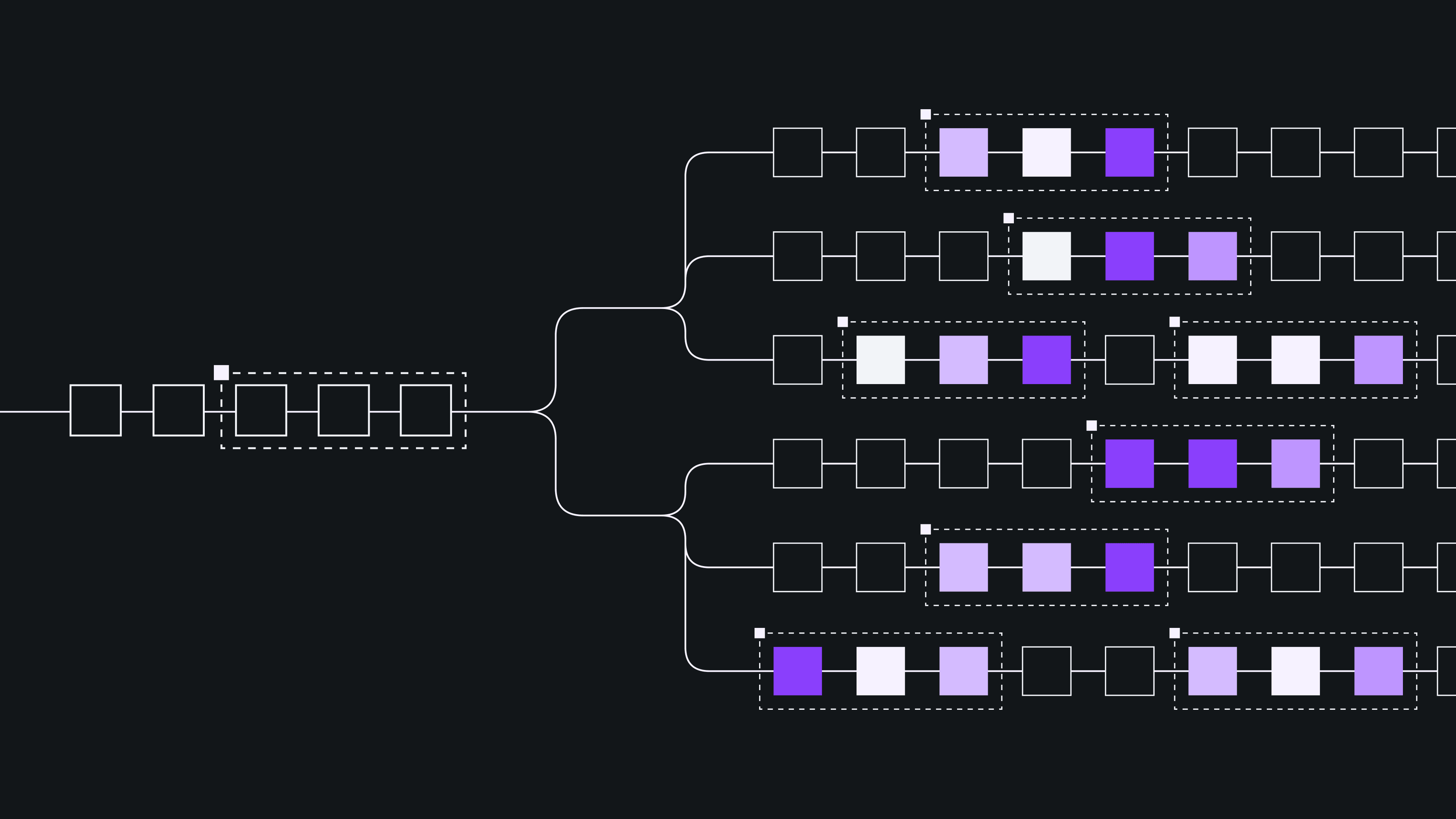
IBM ResearchResearchDirected execution: same performance, more control See, customize, and extend how your circuits use the error mitigation and correction methods researchers are exploring today on IBM quantum hardware

IBM ResearchResearchPonder This Challenge - October 2026 - The Ultimate Ultimate Tic-Tac-Toe Game The well-known game of Ultimate Tic-Tac-Toe is played on a 9 × 9 9\times 9 9 × 9 board (with the rows and columns numbered by 0 , 1 , … , 8 0,1,\ldots,8 0 , 1 , …

IBM ResearchResearchWhy are silicon wafers round? It’s a result of metallurgy, but circular silicon wafers are also the best shape to ensure uniformity in the chip production process.

IBM ResearchResearchFrom error mitigation to fault-tolerant quantum computing A spectrum of error-correcting techniques is enabling useful quantum computation, measured not by logical qubits but by the circuits you can run with them.

IBM ResearchResearchA theoretical separation between quantum computers & LLMs Recent research further demonstrates the theoretical abilities of quantum computing

IBM ResearchResearchIntroducing IBM and NASA's new foundation model for the Moon The multi-modal model could help astronauts navigate craters, investigate ancient lava, and search for ice, as the US plans for a long-term lunar presence.

IBM ResearchResearchSwitzerland's first IBM Quantum System Two Lockheed Martin and IBM are launching a Swiss quantum innovation hub at ETH Zurich to advance research, industry collaboration, and workforce development.

IBM ResearchResearchCleveland Clinic, RIKEN, IBM named Gordon Bell finalists Finalist recognition for one of supercomputing’s top prizes arrives as researchers report new progress in automated quantum-HPC chemistry workflows.

IBM ResearchResearchHow llm-d makes the most of the hardware you already have IBM Research and Red Hat deployed a 753B open model on H100 GPUs, serving thousands of concurrent coding agents at 5-10x lower cost than commercial APIs.

IBM ResearchResearchPonder This Challenge - September 2026 - Loeschian Arithmetic Progressions In a now-famous 2004 article, Ben Green and Terence Tao proved that arbitrarily long arithmetic progressions exist in the primes.

IBM ResearchResearchIBM Quantum Nighthawk r2—more circuits, faster High-speed, independent qubit reset boosts circuit throughput 25x over Heron while enabling accurate observable estimation on circuits with 7,500+ gates.

IBM ResearchResearchWhat happens when information theory accounts for reasoning? At IBM Research, we’re inventing what’s next in AI, quantum computing, and hybrid cloud to shape the world ahead.

IBM ResearchResearchGranite 4.2 brings native reasoning to enterprise agents IBM’s new open Granite models are designed for agentic AI, combining reasoning, tool use, coding, instruction following, and speech capabilities.
Nothing matches this filter yet.